Real talk
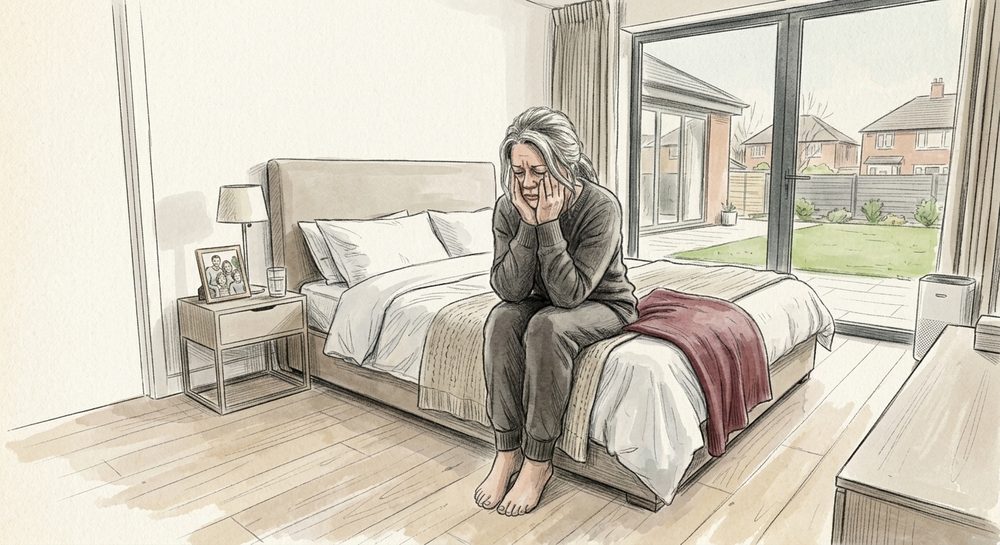
Nobody warns you about this part. Not the hot flushes — everyone mentions those. This is the quieter one: the sense that you're technically still you, going through the motions of your own life, but somehow watching it from a few feet behind yourself. Flatter. Fainter. A shadow of who you were, cast by someone standing just out of frame.
It's not "just tired"
That's the first thing worth saying, because it's the thing everyone reaches for — a friend, a partner, your own inner voice at 2am. "You've just been doing too much." Sometimes that's true. But this particular flatness, the kind that shows up alongside irregular periods and the 3am wake-ups and the sudden inability to find an ordinary word mid-sentence, has a name and a cause: falling and fluctuating oestrogen affects the same brain chemistry involved in mood, motivation, and your basic sense of being switched on. You are not imagining a vibe. Something measurable is genuinely different.
The specific shape it takes
It rarely announces itself as sadness, which is part of why it's so disorienting. More often it's a kind of muting. Things that used to interest you register as slightly grey. You do the things — the school run, the meeting, dinner — competently enough that nobody else notices anything's wrong, which somehow makes it lonelier rather than easier. You catch yourself thinking some version of "I used to have opinions about this" or "I used to laugh at this kind of thing," present tense quietly slipping into past.
Why noticing it is the useful part
Not because noticing fixes it — it doesn't, on its own. But this is exactly the kind of thing that's very hard to describe to a doctor in the moment, and very easy to write down the day it happens. "Felt like I was watching myself from outside today" is a real, usable data point, especially alongside a few weeks of others like it. It's also, frankly, useful to say out loud to one other person, because the specific loneliness of this feeling seems to soften slightly the moment you find out it's common rather than personal.
Worth saying plainly
If this has tipped from a flatness into something heavier — if you're not getting pleasure from anything, or you're having thoughts of harming yourself — that's no longer just a perimenopause symptom to track and wait out. Please tell your GP, or call Samaritans free on 116 123, today rather than later.
I wrote a whole book around this feeling
Partly because I needed to laugh at it before I could do anything more useful with it. A Month of Menopause Madness is a diary of one very ordinary month of exactly this — the flatness, the fury, the 3am spirals, and the days it was all, unexpectedly, quite funny. If today's post found something in you, the book might too.
A Month of Menopause Madness
A diary-format account of one month of perimenopause, written to be read in the moments you actually have — on the bus, at 3am, waiting for the kettle.
Find the book on Amazon →Some links on this page are affiliate links — see our full disclosure. It doesn't change what we recommend.